
Why Is Water Leaking Around a Pipe in My Basement Wall?

Water leaking around a pipe in a basement wall usually has one of two sources: groundwater following the gap between the pipe and the concrete, or a leak in the pipe itself. EPA WaterSense gives homeowners a simple way to start sorting them out: check your water meter before and after a two-hour period when no water is being used, and if the meter moves at all, you probably have a leak. A still meter points you toward the wall and the soil outside it.
Building codes treat the hole around a pipe as a weak spot on purpose. The International Residential Code's section on pipes through foundation walls (P2603.4, as published in Oklahoma's adopted 2018 edition) requires a pipe that passes through a foundation wall to have either a relieving arch or a built-in sleeve two pipe sizes larger than the pipe, and Ohio's version of the 2021 International Plumbing Code (section 305.3) carries the same rule. Garlock's LINK-SEAL engineering manual describes one way to close that space: rubber links bolted between pressure plates that expand to fill the gap between pipe and wall, rated at 20 psig. Below, you will find why these entry points fail, how to tell a pipe leak from seepage, who to call, and how the gap gets sealed.
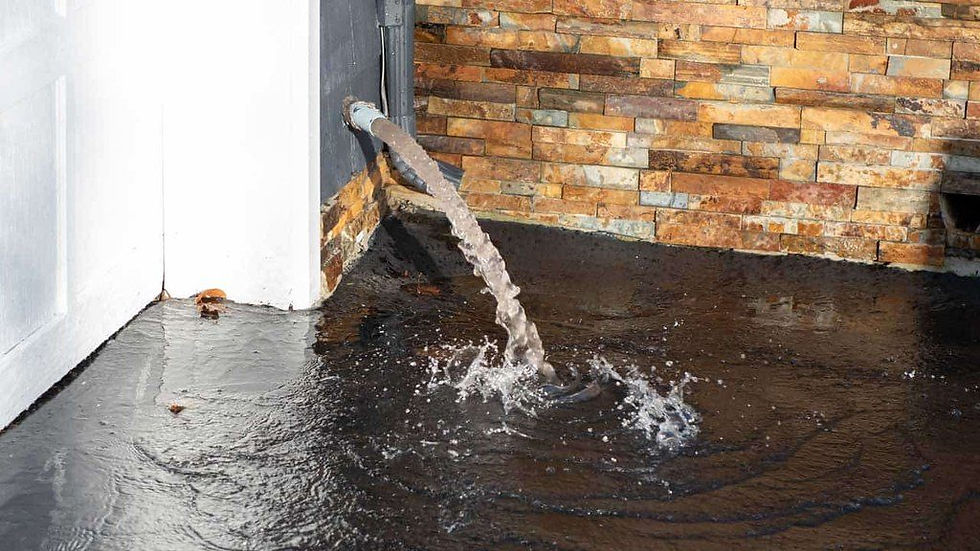
What is a pipe penetration, and why does it start leaking?
A pipe penetration is the opening where a utility line passes through the foundation wall, together with whatever fills the space between the pipe and the concrete or block. In many older homes, that fill is mortar, grout, or a bead of caulk packed in when the line was installed.
Those materials do not last forever. Over years, a few things work against them:
Mortar and caulk shrink, harden, and pull away from the pipe.
The pipe moves slightly with temperature changes and with settling underground.
The soil in the trench dug for the line settles differently from the undisturbed ground around it.
Once a hairline gap opens, it becomes a path. Soil around a foundation that is saturated after rain pushes water against the wall, a force explained in this piece on how hydrostatic pressure affects foundations. The trench backfill along a service line can carry water toward the wall like a buried channel, and the pipe opening is the first place it finds a way in.
Which pipes pass through a basement wall?
Most houses have more than one. Common ones include:
The water service line, usually entering near the meter
The sewer lateral carrying wastewater out to the street
A gas line, on homes where the service enters below grade
Electrical or communications conduit
A sump pump discharge line heading outside
Knowing which pipe is wet decides who fixes it.
How can you tell a plumbing leak from groundwater around the pipe?
Start by drying everything. Wipe the pipe, the wall around it, and the floor below with a towel, then watch where moisture shows up first.
Water that beads on the pipe itself, at a joint, fitting, or valve, points to plumbing.
Water that seeps out of the gap between the pipe and the wall, or darkens the concrete in a ring around it, points to water from outside.
Water that shows up only during or after rain most likely comes from the soil.
Then run the meter test. EPA WaterSense says to read the meter, use no water for two hours, and read it again. Any change suggests a leak somewhere on the pressurized side of your plumbing. Keep in mind that a leak on the buried part of the service line, outside the wall, can also soak the soil and then show up at the penetration. If the meter moves and the only wet spot is around the pipe entry, that combination deserves a plumber's look.
A cold water line can also sweat in humid summer air and drip, which looks like a leak but stops when the air dries out. For a broader checklist, see how to tell whether basement water is coming from outside or inside. If you hear water before you see it, dripping sounds inside basement walls have their own set of causes worth ruling out.
Why is there water leaking around a pipe in my basement wall after rain?
Rain-driven leaks at a pipe entry are a seepage problem. NOAA's 1991 to 2020 normals for Pittsburgh International Airport show 39.61 inches of precipitation a year, plus 44.1 inches of snowfall, so soil around foundations in Allegheny and Westmoreland counties gets wet again and again. Each soaking loads the backfill against the wall, and a failed seal at a pipe lets that water through.
Downspouts that empty near the pipe entry make this worse. The DOE Building America Solution Center recommends discharging downspouts at least 5 feet from the foundation, or underground at least 10 feet away, with grade falling at least half an inch per foot for the first 10 feet. If the water service enters on the same side of the house as a short downspout, fix that first.
If other walls also get damp in the same storm, see why basement walls get wet after heavy rain.
Who should you call about a leak at a pipe entry?
That depends on which pipe it is and whether the water is inside the pipe or around it.
Water service line or sewer lateral
In the city of Pittsburgh, Pittsburgh Water says the water service line from the main up to and including the curb box is its responsibility, while the property owner is responsible from the curb box to the water meter. The entire sewer lateral belongs to the property owner. Pittsburgh Water tells customers to contact a plumber for leaks on their part of the line and to call 412-255-2423 about the public side. Outside the city, rules vary by authority. The Municipal Authority of Westmoreland County, for example, says the water service line from the street to the home is the homeowner's responsibility. Check with your own water provider before assuming who owns what.
Gas lines
Do not chip, patch, or seal around a gas line yourself. If you smell gas, the Pennsylvania Public Utility Commission says to leave immediately, avoid switching lights on or off or using a phone inside, and call 911 and your gas utility from a safe distance.
Seepage around the pipe
When the meter holds steady and the water appears in the gap between the pipe and wall, the problem sits in the wall, not the plumbing. That is work for a basement waterproofing contractor. In Pennsylvania, home improvement contractors register with the Attorney General, and you can check a registration at hicsearch.attorneygeneral.gov.
How is a leaking pipe penetration sealed?
The right method depends on the pipe, the wall, how much the pipe moves, and whether water is actively running.
Hydraulic cement is the familiar quick fix. Quikrete describes its Hydraulic Water-Stop Cement as designed to plug leaks in concrete and masonry and to block running water, and says it sets in 3 to 5 minutes. It forms a rigid plug, so it works best around a pipe that does not shift.
Polyurethane injection pushes a liquid resin into the gap and the cracks around it. Prime Resins lists pipe penetrations among the uses for Prime Flex 910, a water-activated, hydrophobic polyurethane injection resin that reacts with moisture to form a watertight mass. Injection can reach water paths behind the wall surface that a surface patch never touches. The same approach is used for many foundation cracks, as described in this overview of how basement wall crack repair is done in Pittsburgh.
Mechanical link seals fill the space between a pipe and a sleeve or core-drilled hole with bolted rubber links. Garlock's manual explains that the seal size is chosen from the annular space, half the difference between the pipe's outside diameter and the opening's inside diameter. This is typically part of a new or redone penetration rather than a patch.
Whatever the method, sealing only the inside face of the wall can leave water sitting in the wall behind it. If the leak returns, that is a sign the entry needs to be opened up and addressed properly, or that more water is reaching that wall than a seal can hold back. A professional basement waterproofing inspection can show which situation you have.
FAQ
Is water around the pipe where my water line enters the basement a plumbing problem?
Not always. Run the EPA meter test first: if the meter moves during two hours of no use, call a plumber. If it holds steady and the water appears after rain, it is usually groundwater coming through the gap around the pipe.
Can I just caulk around the pipe myself?
Caulk on the inside face may slow a small seep, but it does not stop water already in the wall and can fail as the pipe moves. Never seal around a gas line on your own.
Why does the leak only show up in spring?
Snowmelt and spring rain saturate the soil at the same time. NOAA's normals for Pittsburgh International Airport show 44.1 inches of snowfall a year, and much of that melt soaks into the soil around foundations.
Does homeowners insurance cover water leaking around a pipe in a basement wall?
Coverage depends on the cause and your policy wording. The Pennsylvania Insurance Department notes that flood is not covered by standard homeowners policies. Ask your insurer how your policy treats seepage versus a sudden pipe leak.
What is a pipe sleeve?
A pipe sleeve is a larger pipe built into the foundation wall that the utility line passes through. The International Residential Code, as adopted in states such as Oklahoma, calls for a sleeve two pipe sizes larger than the pipe when a relieving arch is not used. Your municipal code office can tell you which edition applies to your home.
Help for Leaks Around Basement Pipes From A Better Choice, Inc.
Since 1996, A Better Choice, Inc. has served over 26,000 satisfied customers in the Greater Pittsburgh area, fixing wet basements across Westmoreland, Allegheny, Butler, and neighboring counties. If water is seeping in around a pipe entry in your foundation, the family- and veteran-owned team offers a free inspection to find where the water is getting in and explain your options. Learn more about our Pittsburgh basement waterproofing work.
Visit A Better Choice, Inc. or call 1-800-343-2357 today. Contact us for more information.


Comments