
Why Is My Porch Pulling Away From the House?

A porch pulling away from the house is usually a sign that the porch is moving on its own support while the house stays put. Porches and additions often sit on separate footings or fill soil, so when the ground under them settles, washes out, or heaves with frost, the gap opens at the joint. Penn State's Pennsylvania Housing Research Center explains that the base of a foundation must extend below the regional frost depth to keep the soil beneath it from heaving, and a porch that was built shallower than that has little protection.
That frost line is a local number, not a guess. Section R403.1.4.1 of the International Residential Code covers frost protection for footings, and Pennsylvania municipalities apply it locally: Cranberry Township in Butler County, for example, states on its residential permit page that deck footings must be 36 inches below grade for approval. This post covers why porches and additions are separate, how to measure and track the gap, which warning signs mean stop using the porch, and what repair options and permits usually look like in Western PA.
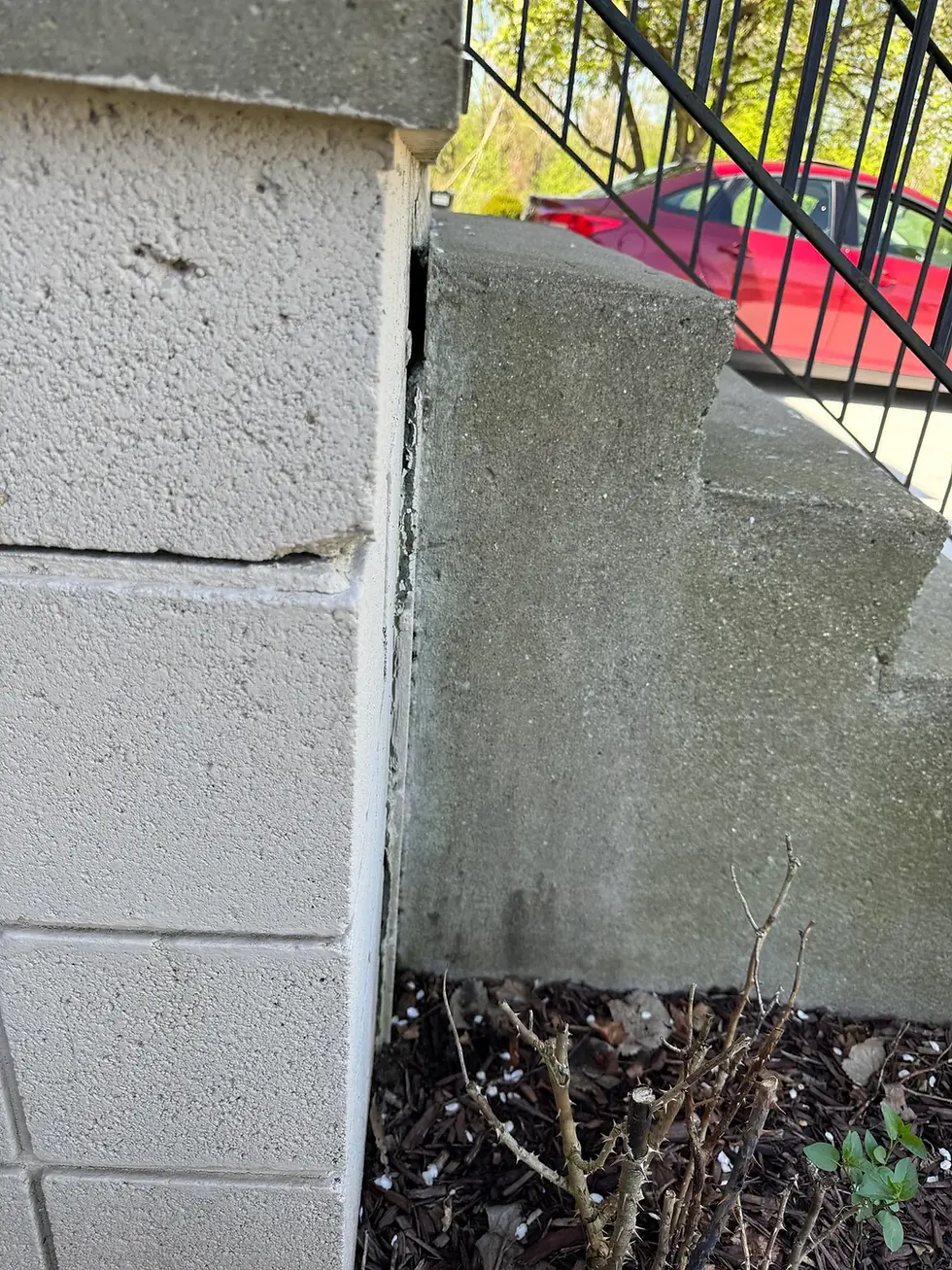
What does it mean when a porch separates from the house?
Porch separation is movement between two structures that were supposed to stay together: the house foundation and the porch's own base. The house typically rests on deep footings under a basement or crawl space. A concrete stoop, a slab porch, or a framed wood porch may rest on a thinner slab, shallow piers, or soil that was backfilled against the foundation wall after the basement was dug.
When that softer base compacts, the porch tips outward or drops at the far edge, and a wedge-shaped gap appears where it meets the siding or brick.
Additions follow the same pattern. A sunroom or family room added decades after the original house has its own footings, poured by a different crew to whatever standard applied at the time. If those footings were shallow or sit on fill, the addition can drift away from the main house and crack the seam between old and new walls.
What causes a front porch to sink or pull away?
Four causes show up again and again. More than one is often at work.
Soil settlement under the porch
Loose fill compresses under the weight of concrete steps and slabs. Settlement tends to show up as a porch that slopes toward the yard, steps that sit lower than they used to, or a slab with a diagonal crack. Our post on what causes foundation sinking in Pittsburgh homes explains how soil type and moisture drive this.
Water from roofs and downspouts
A downspout that dumps next to the porch saturates the soil and can wash fines out from under a slab. The Department of Energy's Building America Solution Center recommends that downspouts discharge at least 5 feet from the foundation, or underground at least 10 feet away, and that the ground fall at least 0.5 inch per foot for the first 10 feet. Pittsburgh averages 39.61 inches of precipitation a year according to NOAA's 1991 to 2020 normals, so a short or disconnected downspout gets plenty of use. See why downspouts cause foundation problems for more on this.
Frost heave
When wet soil freezes, it expands and lifts whatever sits on it. NOAA's normals put Pittsburgh International Airport's January mean temperature at 28.8 F, so the ground freezes and thaws repeatedly most winters. A porch on shallow supports can rise in winter and settle unevenly in spring, loosening the joint a little more each cycle. Heave and settlement look alike from the outside, and our guide to foundation settlement vs. foundation heave walks through how to tell them apart.
A rotted or poorly fastened ledger on a wood porch
Framed wood porches often hang one side on a ledger board bolted to the house. The American Wood Council states that deck collapses most often result from ledger connections built with nails instead of properly installed bolts, and that ledgers must be flashed or caulked to keep water off the house band joist. The International Code Council notes that the IRC has required deck ledgers to be connected with half-inch bolts or lag screws since 2009. A wet, rotting ledger can let the porch sag or pull outward.
How do you measure a porch pulling away from the house?
Tracking the gap over time tells you far more than one measurement.
Mark both sides of the gap at the top and bottom with a pencil or paint pen.
Measure the width at each mark with a tape or ruler and write down the date.
Lay a level on the porch floor and on the top step, and note which way it slopes.
Repeat every few weeks, and again after a hard freeze or a heavy storm.
A gap that stays the same for months points to old movement that may have stopped. A gap that keeps widening, or grows wider at the top than the bottom, suggests the porch is still rotating away from the house. Check inside, too. Cracks in the basement wall behind the porch, or new sticking at the front door, can mean the movement is not limited to the porch. The early signs a home is shifting unevenly are a useful checklist for that.
Is a porch pulling away from the house dangerous?
Sometimes it is, and the risk is usually to people using the porch rather than to the house itself. Stop using the porch, or block it off, and call for an inspection if you see:
Railings or guards that wobble or have pulled loose at the post
Steps that rock, tilt sideways, or have separated from the landing
A wood porch where the ledger has visibly pulled away from the band board
Soft, spongy, or split framing near the house connection
A gap wide enough to catch a foot or a cane
The ICC points out that decks have collapsed with as few as one or two people on them when the house connection failed. A porch that shares that type of connection deserves the same caution.
Water is the slower problem. An open joint lets rain run down the face of the foundation wall behind the porch.
How is a porch or addition pulling away from the house fixed?
Repairs range from simple drainage work to new structural support. Which one fits depends on what is moving, how fast, and whether the soil under the porch can still carry it.
Drainage comes first in almost every case. Extending downspouts, regrading so water runs away from the porch, and sealing the joint after movement stops can be enough for minor, stable settlement.
Re-supporting the porch is the next step up. For wood porches, that can mean new footings dug below the frost line, new posts, and a properly bolted and flashed ledger. For concrete stoops, contractors may lift and fill under the slab or remove and replace it on a proper base.
For heavier structures and additions, deeper support may be needed. Our foundation repair page describes helical piers and push piers for sinking foundations, and our comparison of push piers vs. helical piers in Western PA explains how each one works. Whether any of these fits a specific porch or addition is something an on-site inspection can determine.
Do you need a permit to fix a porch in Western PA?
Often, yes, for structural work. Pennsylvania's Department of Labor and Industry says more than 90 percent of the state's municipalities administer the Uniform Construction Code locally, either with their own staff or through certified third-party agencies. Pennsylvania adopted the 2021 International Codes effective January 1, 2026, as reported by the law firm Cohen Seglias. That means your township or borough office, not a statewide office, is usually where you ask.
Cranberry Township, for example, lists unenclosed porches among the projects that need a residential building permit. Rules differ from one municipality to the next in Allegheny, Westmoreland, and Butler counties, so call your local code office before rebuilding footings, steps, or a ledger.
FAQ
Can I just fill the gap between my porch and the house?
You can seal it with a flexible exterior sealant to keep water out, but that only makes sense once the porch has stopped moving. If the gap is still growing, the sealant will tear and the underlying cause will keep working.
Why is my concrete porch sinking but my house is not?
The house typically sits on deeper footings, while many concrete porches sit on shallower supports or on soil that was backfilled after the basement was built. That softer soil settles or erodes, and the porch drops without the house moving.
Does homeowners insurance pay for a porch pulling away from the house?
Coverage varies by policy and by cause. The Pennsylvania Insurance Department notes that flood is not covered by standard homeowners policies, and PA DEP says mine subsidence damage is usually not covered either, which is why DEP runs a separate Mine Subsidence Insurance program. Ask your insurer how your policy treats the specific cause of the movement.
How fast does a porch pull away from a house?
The rate varies with soil, water, and how the porch is supported, so there is no standard timeline. Measuring and dating the gap every few weeks is the most reliable way to know whether it is active.
Can a porch pulling away damage my foundation?
The open joint can direct roof and surface water down the foundation wall behind the porch. If you see new cracks or dampness on that basement wall, have the foundation inspected along with the porch.
Is an addition pulling away from the house the same problem?
The mechanics are the same: two structures on different footings moving at different rates. Additions are larger, so they should be evaluated in person.
What should I do first?
Redirect nearby downspouts, start tracking the gap, and keep people off the porch if railings or steps are loose. Then schedule an inspection.
A Better Choice, Inc. Can Inspect Your Porch Separation
A Better Choice, Inc. has served the Greater Pittsburgh area since 1996 and offers a free inspection for foundation concerns in Westmoreland, Allegheny, Butler, and neighboring counties. If your porch or addition is pulling away from the house, we can look at the foundation, drainage, and soil around it and explain your options. The family- and veteran-owned company is based in North Huntingdon and serves towns including Irwin, Greensburg, Monroeville, Murrysville, and Cranberry Township.
Visit A Better Choice, Inc. or call 1-800-343-2357 today. Contact us for more information.


Comments