
How Do You Monitor a Foundation Crack?

You monitor a foundation crack by marking it, measuring its width at the same fixed points on a regular schedule, and writing each reading down with the date so you can compare them later. The Building Research Establishment's BRE Digest 251 recommends collecting "a series of measurements with time of the widths of cracks" over six months to a year before deciding what is causing the damage. A pencil, a ruler, a phone camera, and a plastic foundation crack monitor are enough to start.
BRE Digest 251, a UK engineering guide to damage in low-rise brick and block buildings, sorts cracking into six categories from 0 to 5 by typical width and how hard the repair is, then groups them: categories 0 to 2 are "aesthetic" damage, 3 and 4 are "serviceability" damage, and 5 is "stability" damage. The same digest warns that damage should not be classified "solely on crack width," which is why your log needs more than one number. This post covers a practical setup for a Western Pennsylvania basement, what to log, and when to stop watching and call.

What does it mean to monitor a foundation crack?
Crack monitoring is the repeated measurement of the same crack, at the same marked points, over enough time to tell whether it is still moving. A single measurement tells you how wide a crack is today. A series tells you whether it is getting wider, getting longer, shifting sideways, or holding still.
A crack that opened years ago and stopped is a different problem from one still moving. If you have not yet decided whether your crack is worth watching, our post on how to tell if basement cracks are serious walks through crack types first.
How do you set up a foundation crack monitor at home?
Start the day you notice the crack.
The pencil, ruler, and photo method
Clean the wall along the crack with a dry brush so marks will stick.
Draw a short pencil line across each end of the crack, exactly where it stops, and write the date beside each line. If the crack grows past a line, you will see it.
Pick two or three measuring spots along the crack, usually the widest point and one near each end. Number them on the wall in pencil or marker.
Measure the width at each numbered spot with a ruler marked in millimeters, or with a crack width gauge card held against the crack.
Photograph each spot straight on, with the ruler touching the wall beside the crack and a sticky note showing the date in the frame. Stand in the same place each time.
How a two-plate tell-tale works
A tell-tale is a small plastic gauge fixed across the crack. Avongard, a maker of these monitors, describes its standard tell-tale as "two plates which overlap for a part of their length." The bottom plate carries millimeter markings, and the top plate is transparent with "a hairline cursor in the form of a cross." Each plate is attached to the wall on its own side of the crack, so when the wall moves, the crosshair slides across the grid.
Because the grid runs in two directions, a telltale shows both opening and sideways or up-and-down shifting. Gilson's Standard Crack Monitor lists a range of 20 mm (0.78 in) horizontally and 10 mm (0.39 in) vertically, with 1 mm readability. Avongard says its tell-tales are calibrated to 1.00 mm and can be read by interpolation to 0.5 mm, and that they should ideally be fixed "with screws/plugs and adhesive." Record the crosshair position on the day you install it. That first reading is your zero.
How often should you measure, and why do seasons matter in Pittsburgh?
Measure monthly at the same numbered spots, and add an extra reading at each change of season. Keep it up for at least six months, and a full year if you can, so you see summer and winter conditions.
Seasons matter because cracks breathe. Avongard's FAQ notes that "a crack in a building will behave in a similar way to a movement joint," expanding and contracting as temperatures change, and BRE Digest 251 describes cracks that "open and close seasonally" where ground moisture changes through the year. Pittsburgh's swings are large enough to show up: NOAA's 1991 to 2020 normals for Pittsburgh International Airport put the January mean temperature at 28.8 F, with 44.1 inches of snow and 39.61 inches of precipitation a year. A crack that is slightly wider in January and narrower in July, and returns to the same numbers each year, reads differently from one that ratchets wider every season.
For more on that pattern, see why foundation cracks keep reappearing after they are patched.
What should a crack log include?
A notebook or a phone spreadsheet works. Give each reading its own row with:
Date and outdoor weather (dry spell, heavy rain, freeze)
Width at each numbered spot
Tell-tale reading, both horizontal and vertical
Whether the crack has passed either pencil end mark
Any offset, meaning one side of the crack sitting further out or higher than the other
Water, dampness, or white mineral staining at the crack
Doors or windows upstairs that started sticking
Photo file names
Offsets deserve their own column. A crack whose edges stay flush is only opening. A crack where one face has pushed out past the other is showing movement in a second direction, and a two-axis tell-tale is the easiest way to catch it early.
How do BRE Digest 251 crack widths help you read your numbers?
The digest lists typical widths for each damage category, for brick and blockwork:
Category 0: hairline cracks under about 0.1 mm, "negligible," no action required
Category 1: fine cracks up to about 1 mm (0.04 in), treated with normal decoration
Category 2: up to about 5 mm (0.2 in), "cracks easily filled," doors and windows "may stick slightly"
Category 3: 5 to 15 mm (0.2 to 0.6 in), cracks a mason must open up and patch; "doors and windows sticking," service pipes may fracture
Category 4: 15 to 25 mm (0.6 to 1 in), sections of wall broken out and replaced; walls "leaning or bulging noticeably"
Category 5: over 25 mm (1 in), major repair with partial or complete rebuilding
Two cautions apply. The digest is a UK document written for brick and block, not a U.S. building code, and it says itself that width alone can give "a misleading concept of the true scale of the damage." Treat the categories as a way to put your readings in context, then weigh the trend, the direction, and the other symptoms in your log. Small cracks can still grow, which we cover in whether small basement wall cracks get worse.
What changes mean a foundation crack is getting worse?
Look for movement that keeps going in one direction instead of cycling with the seasons. The warning signs to note in your log:
Width that grows reading after reading, not just in winter
A crack that passes one of your dated pencil end marks
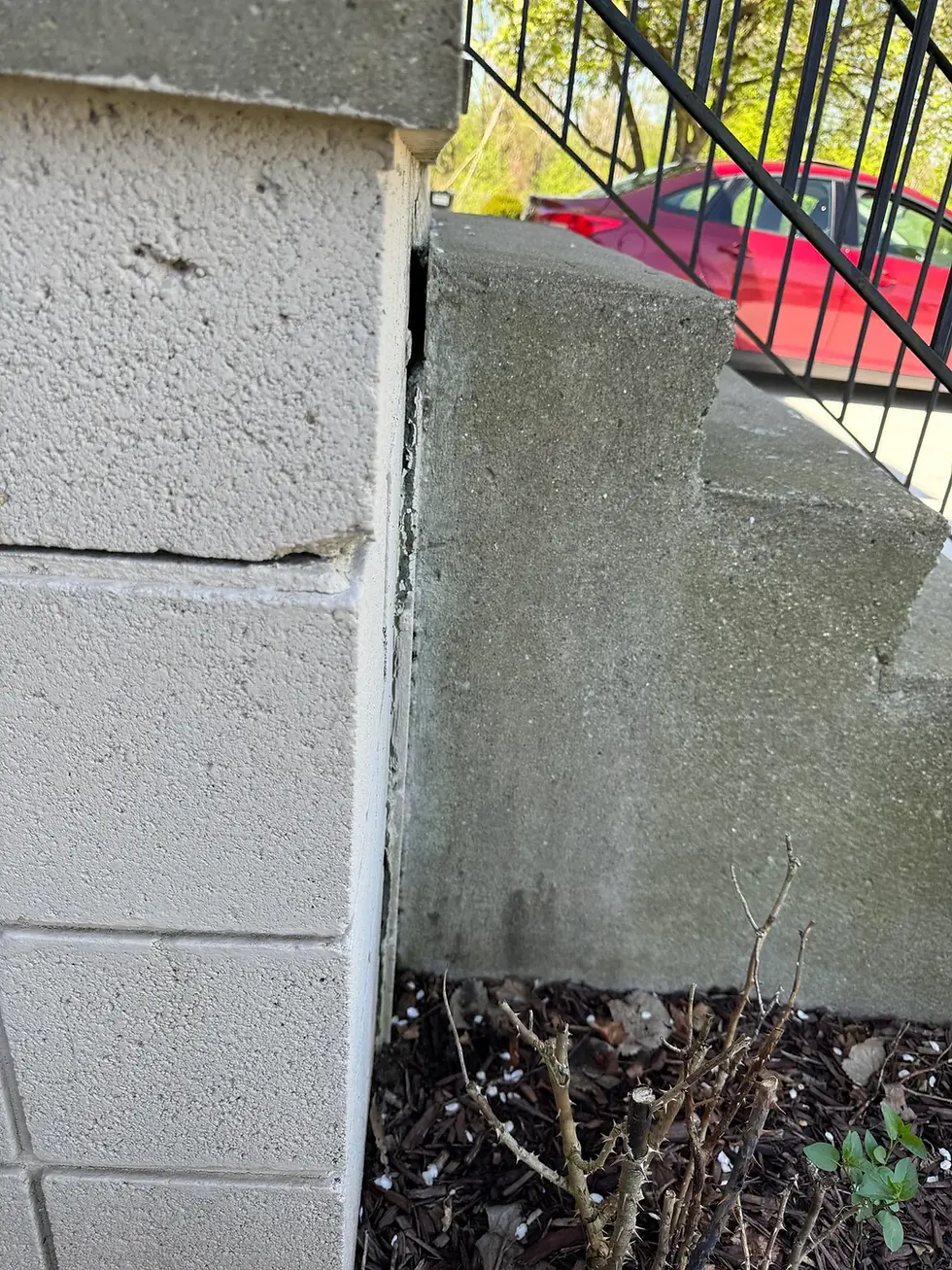
One side of the crack shifting out or dropping relative to the other
New diagonal or stair-step cracks nearby, especially running from window or door corners
Doors and windows that start to stick, which BRE Digest 251 lists alongside category 2 and 3 cracking
Any one of these is worth a professional look, and width growth plus offset together points to an active crack.
When should you skip monitoring and call someone now?
Some cracks should not go on a six-month watch list. InterNACHI, the home inspector association, describes a crack caused by saturated soil pushing on a basement wall as "usually horizontal, open more than hairline," and showing "signs of water intrusion," and says the pressure "forces the wall to bend inward."
Call for an inspection without waiting if you see:
A horizontal crack in a block or poured wall, especially partway up the wall
Any bowing, bulging, or leaning, which BRE Digest 251 places in category 4 damage
Water coming through the crack
A crack wide enough that a telltale's range would be used up quickly
Water through a crack is a separate problem even when the wall itself is stable, and basement waterproofing addresses where that water comes from. Bowed or leaning walls fall under foundation repair.
FAQ
Can I use tape instead of a crack monitor?
Pencil lines on the wall at each end of the crack, plus dated photos with a ruler in the frame, will show growth in length and rough changes in width. A tell-tale adds sideways and vertical movement, which tape and pencil do not measure well.
How long should I monitor a foundation crack?
BRE Digest 251 suggests a series of readings over six months to a year. In the Pittsburgh area, a full year lets you compare a winter with a summer.
Is a crack that gets wider in winter a problem?
Not by itself. Cracks expand and contract with temperature, so a seasonal swing that returns to the same readings is expected. A crack that is wider each winter than the winter before is a different story.
What size foundation crack is serious?
BRE Digest 251 places cracks of 5 to 15 mm (0.2 to 0.6 in) in category 3, the first "serviceability" category, but it warns against judging on width alone. Direction, offset, water, and change over time matter too.
Where do I buy a crack gauge?
Tell-tale crack monitors and crack width cards are sold by testing equipment suppliers such as Gilson and Avongard. Pick a two-axis model if you want to track sideways movement.
Should I fill the crack while I monitor it?
Filling it hides the evidence. Leave it open until your readings show whether it moves, unless water is coming in; then get it inspected.
Watching a crack in Westmoreland or Allegheny County?
A Better Choice, Inc. has served homeowners in the Greater Pittsburgh area since 1996, with over 26,000 satisfied customers. The family- and veteran-owned company offers a free inspection, where the team can look at the crack along with the notes and photos you have kept. When a crack turns out to be active, the team explains options for basement wall crack repair in Pittsburgh and structural fixes such as Fortress Stabilization Straps for bowed walls.
Visit A Better Choice, Inc. or call 1-800-343-2357 today. Contact us for more information.



Comments